
Your Body Has a Calm Switch — And It May Help You Heal
- Jasper Van Remundt
- Apr 28
- 4 min read


There is a nerve in your body that runs from your brain all the way down to your gut. It passes through your heart. It touches your lungs. Scientists call it the vagus nerve — from the Latin for "wandering" — and for most of history, it was simply the nerve that connected the brain to the body.
But new research is beginning to tell a different story.
A 2026 paper published in Frontiers in Oncology found that in breast cancer patients, higher vagal tone — a measure of how well the vagus nerve is functioning — was associated with decreased inflammation, better sleep, less fatigue, and improved quality of life during and after treatment. And a systematic review and meta-analysis published in BMC Cancer found something even more striking: higher vagus nerve activity predicted better cancer prognosis across multiple cancer types, independently of age, stage, or treatment.
In other words: the state of your nervous system may matter more to your recovery than most people realise.
What vagal tone actually means
Think of it this way. Your nervous system has two primary gears.
One is for threat — the fight-or-flight gear, where the body prepares to defend itself. The other is for safety — the rest-and-repair gear, where the body heals, digests, processes emotion, and rebuilds.
The vagus nerve is the main pathway of that second gear.
When vagal tone is high, your body spends more time in the rest-and-repair state. Inflammation goes down. Sleep improves. The immune system does its work more efficiently. You feel, over time, more like yourself.
When vagal tone is low — as often happens during prolonged stress, fear, or a cancer diagnosis — the body stays in low-grade threat mode. Healing slows. Sleep suffers. Everything feels harder.
The good news is that vagal tone is not fixed. It is something you can train.
Ancient wisdom, modern confirmation
Dan Harris, writing this week about the vagus nerve, put it simply:
"Connection may be one of the oldest nervous system regulation tools we have."
He was talking about warm, trusting human connection — the kind that involves real eye contact, a hand on the shoulder, laughter, feeling genuinely understood. This kind of connection directly activates the vagus nerve. It tells your body, at a biological level, that you are safe.
This is not new wisdom. Ayurveda has long held that the quality of your relationships is part of your medicine. Yoga philosophy teaches that the breath is the bridge between the conscious and the unconscious — between the mind and the body. The slow exhale, the soft gaze, the quiet moment of presence with another human being — these are ancient technologies.
What is new is the science that confirms what the ancients already understood.
At Holistic Path, we have always said: the nervous system is the first medicine. This means that no practice, no herb, no protocol can reach its full potential in a body that is stuck in threat. Safety comes before healing. Regulation comes before transformation. Not as a spiritual idea — as a biological fact.
"The calm you have been looking for is not separate from your healing. It is the doorway to it."
What this looks like in practice
So what does this look like when you are navigating treatment, recovery, or the uncertainty that follows?
A few simple, evidence-informed starting points:
Slow your exhale.
Breathing at a rate of about five to six breaths per minute — with a longer out-breath — is one of the most direct ways to activate the vagus nerve. You don't need a technique. You just need to breathe out a little more slowly than you breathe in. Three seconds in, six seconds out. That is enough.
Rest deeply.
Yoga Nidra — the yogic practice of conscious relaxation — has been shown in a recent randomised controlled trial to significantly reduce fatigue, pain, and psychological distress in cancer patients undergoing treatment. Twenty minutes of Yoga Nidra is said to offer the restorative equivalent of several hours of sleep. You don't need to do anything. You just need to lie down.
Seek warm connection.
Not the performance of connection — the real thing. Someone whose presence makes you feel safe. A conversation where you feel heard. Laughter, where it comes naturally. These are not luxuries. According to the research, they are nervous system medicine.
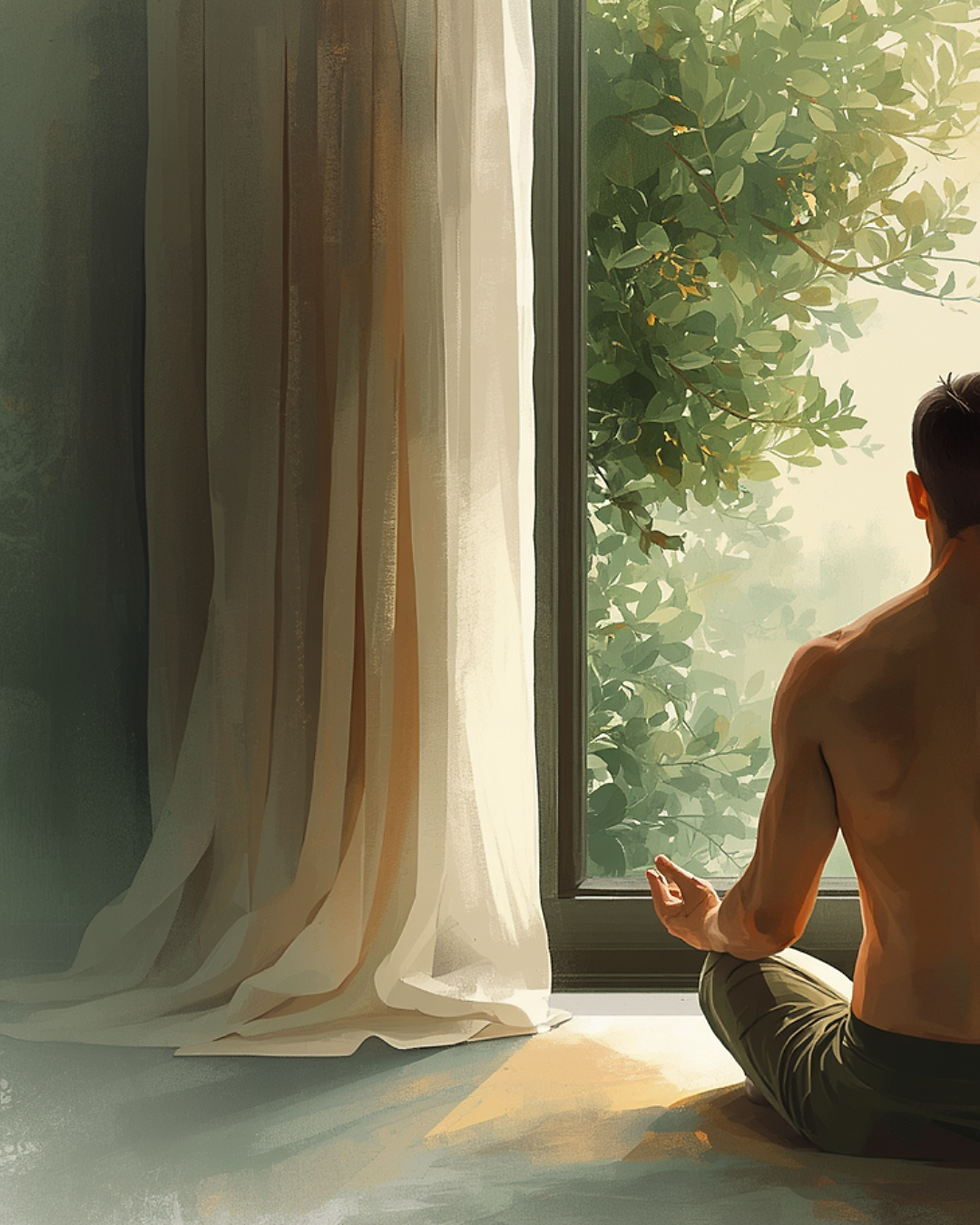
Let yourself be still.
Not because stillness is comfortable — it often isn't at first. But because the body needs permission to stop scanning for threat. A few minutes sitting quietly in nature, feeling the ground beneath you, noticing the sounds around you — these moments tell your nervous system that the emergency is not continuous.
You do not need to do all of these things. You do not need to do them perfectly. One small practice, done gently and consistently, begins to shift the landscape.
A grounded closing
The research is catching up to what many ancient traditions have known for centuries: your inner state is not separate from your physical health. The breath you take right now. The quality of your rest tonight. The warmth of the connection you share this week. These are not nice-to-haves at the edge of your cancer journey. They are at the centre of it.
Your nervous system is not just responding to your healing. It may be shaping it.
Start where you are. Start small. A long exhale. A quiet moment. A conversation that makes you feel seen.
That is already medicine.
✶ —————————————— ✶
What is one moment today when you could let yourself exhale — fully, slowly, without rushing toward what's next?
No noise. Just thoughtful emails when it matters.


Comments