
The Unexpected Fear That Comes After Cancer Remission
- Jasper Van Remundt
- Mar 13
- 5 min read


The word 'remission' carries the weight of a thousand prayers. After months — or years — of chemotherapy, scans, waiting rooms, and sleepless nights, it arrives like an exhale you have been holding for so long you had almost forgotten how to breathe. And yet, for many people walking this path, what follows is not simply relief. It is fear. A quiet, unsettling, deeply confusing fear that nobody warned them about.
If you have reached remission and found yourself wondering why you are not celebrating, why every headache makes your heart race, or why you feel more anxious now than you did during treatment — you are not alone. This experience is known, it is understood, and it has a name: fear of cancer recurrence. And within the framework of holistic cancer coaching and oncology wellness, it is one of the most important — and most overlooked — parts of the healing journey.
This post is written for you. Not to fix the fear, not to rush you past it, but to sit with you inside it — and then, gently, to offer a way through.
When Relief Feels Distant: The Other Side of Treatment
During active treatment, there is a strange kind of structure to cancer. You have appointments. You have a protocol. You have a team. The enemy is identified, the battle plan is drawn, and every week brings a clear set of tasks. Your nervous system, as exhausting as this is, knows exactly what it is doing: surviving.
When treatment ends, that structure disappears. The appointments thin out. The oncologist becomes a quarterly check-in. The nurses who knew your name are now serving someone else's emergency. And you are left standing in what should feel like freedom — but instead feels like the ground has shifted beneath your feet.
This is not weakness. This is biology. A nervous system that has spent months in high-alert survival mode does not simply reset because a doctor gives you the word 'remission.' The alarm system remains primed. The body is still listening for the next threat. In the language of oncology wellness, we call this hypervigilance — and it is one of the most common and least spoken-about experiences after cancer treatment ends.
Every ache becomes a question. Every scan date becomes a countdown. Every unexpected symptom sends the mind spiralling into worst-case scenarios before you have even had a chance to take a breath. And layered beneath all of this is something even harder to name: the loss of the person you were before. Cancer does not leave you unchanged. And the identity of 'cancer patient' — however painful — had become familiar. Who are you now, on the other side?
Why the Fear Is Not the Enemy
There is a tendency, in wellness culture and even in medicine, to treat fear as a problem to be solved. To reassure, to reframe, to hurry people into gratitude. And while gratitude is real and beautiful and important, rushing there too quickly can leave the most tender parts of your experience unseen.
In the Holistic Path framework — which draws on yoga, Ayurveda, and modern understanding of the nervous system — we approach fear not as an enemy but as information. Fear after cancer remission is the body's way of saying: I have been through something enormous. I have not yet processed it. I am not yet sure I am safe. And I need your attention, not your dismissal.
This does not mean living inside fear indefinitely. It means honouring it long enough to understand what it is asking for. Often, what it is asking for is simple: connection. Stillness. A felt sense of the body as something trustworthy again. Cancer mindfulness practices, rooted in compassionate self-awareness, offer exactly this — not a cure for anxiety, but a way of meeting it with enough steadiness that it no longer runs the room.
"Cancer does not break people. Fear does. Confusion does. Disconnection does." — Holistic Path
The research on post-treatment psychological support is unambiguous: people who receive structured guidance in managing fear of recurrence after cancer — including mindfulness-based interventions, yoga, breathwork, and community — report significantly better quality of life, reduced anxiety, and improved sleep. Oncology wellness is not a luxury. It is a clinical need that most healthcare systems are still learning to meet.
Practices That Help You Come Home to Your Body
If fear after remission lives anywhere, it lives in the body. In the chest that tightens before a scan. In the shallow breath before the results call. In the shoulders that have been held up near the ears for so long they have forgotten how to drop. The path back to safety, then, begins in the body — not in the mind.
Healing through yoga offers something that conventional medicine rarely has time to provide: a slow, attentive, breath-led return to the body as home. Not a yoga of performance or flexibility, but a yoga of listening. Restorative poses. Yoga nidra — the practice of conscious rest — which research shows to be deeply effective at regulating the autonomic nervous system and reducing cortisol levels elevated by chronic stress and cancer treatment.
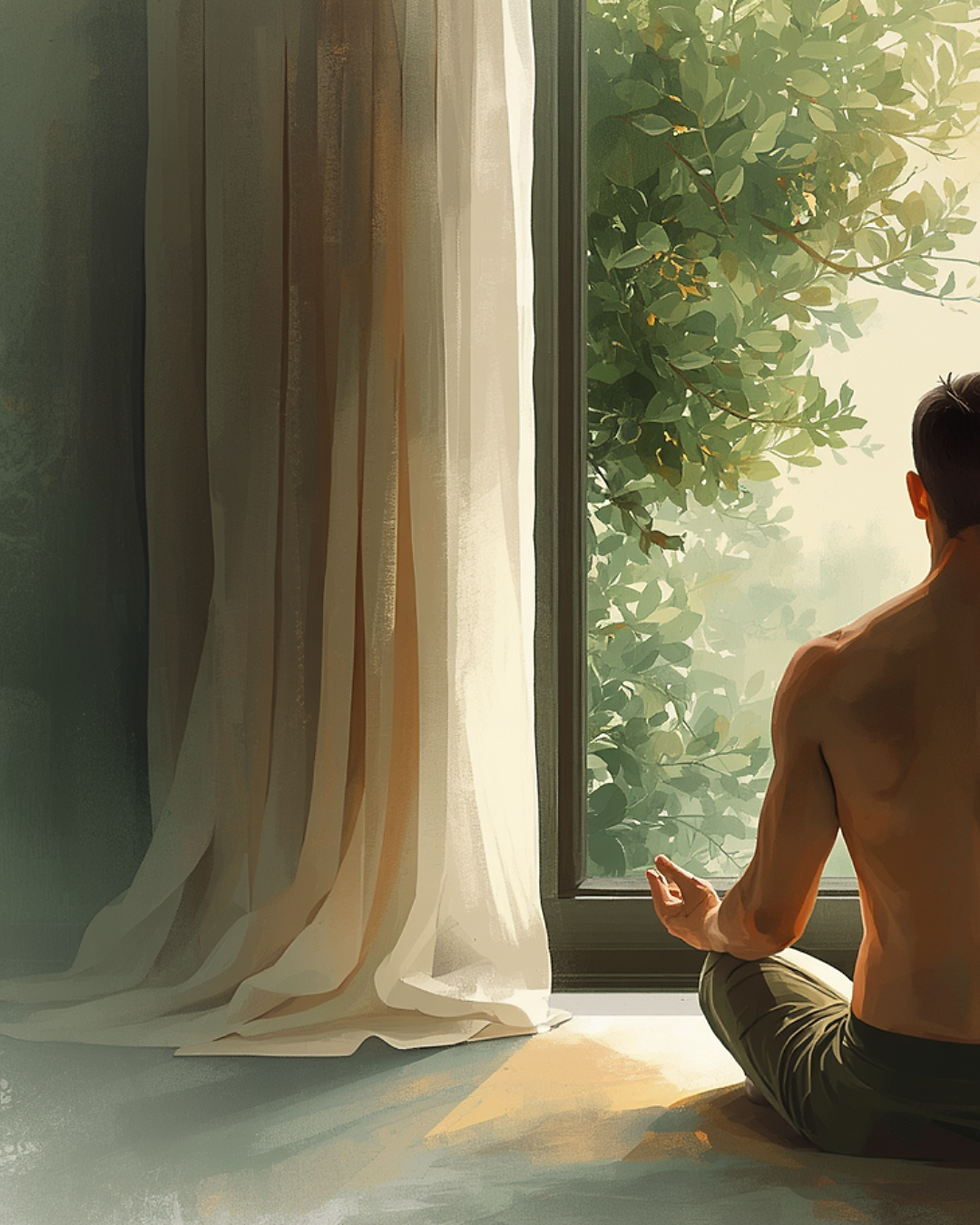
Alongside healing through yoga, cancer meditation practices offer another doorway. A simple ten minutes of daily sitting — following the breath, noticing the thoughts without being swept away by them, returning again and again to the present moment — begins to rewire the brain's relationship with threat. Not by denying that cancer happened, but by building a quieter, more grounded place to stand.
Pranayama — the yogic science of breath — is particularly powerful for the post-remission nervous system. Techniques such as nadi shodhana (alternate nostril breathing) and the extended exhale have been shown to activate the parasympathetic nervous system directly, shifting the body out of fight-or-flight and into rest-and-digest within minutes. This is not metaphor. This is physiology.
In the Ayurvedic tradition, the post-treatment period is understood as a time of deep rebuilding — not just of tissue and energy, but of ojas, the vital essence that is depleted by illness and the toxicity of treatment. Gentle daily rhythms, nourishing foods, oil massage, early sleep, and time in nature are all seen as medicine. Not because they prevent cancer from returning, but because they restore the conditions in which the body and mind can heal, rest, and recalibrate.
From Surviving to Truly Living: A Gentle Invitation
The transition from cancer patient to cancer survivor — and eventually, simply to a person living a full life — is rarely linear. There will be good days and harder ones. There will be scan dates that bring dread, and anniversaries that bring unexpected grief. There will be moments of profound gratitude and moments where the fear edges back in.
This is not failure. This is the texture of a life that has been touched by something profound. The goal of holistic cancer coaching is not to arrive at a place where cancer never crosses your mind again. The goal is to build a relationship with yourself that is strong enough, soft enough, and spacious enough to hold all of it — the fear, the beauty, the uncertainty, and the extraordinary fact that you are still here.
Small practices transform a life. Not grand gestures, not radical overhauls, but the quiet daily return to breath, to body, to the things that remind you who you are beyond the diagnosis. Cancer mindfulness is not about spiritual bypassing or toxic positivity. It is about honest, grounded presence — meeting each day with as much openness as you can, and forgiving yourself gently on the days when that feels impossible.
You are not broken. You are not failing at recovery. You are a person who has been through something immense — and you deserve support, guidance, and a framework that honours every part of that experience.
If you are navigating life after cancer and would like to explore a holistic, personalised approach to rebuilding your wellbeing — one that weaves together yoga, Ayurveda, nervous system support, and compassionate coaching — I invite you to learn more about the Holistic Path framework. You do not have to walk this part of the journey alone.


Comments