
Healing Begins Where the Fighting Stops
- Jasper Van Remundt
- Apr 27
- 5 min read

What Science and Ancient Wisdom Say About Acceptance in Cancer Recovery

There is a moment many people describe somewhere along the cancer journey.
Not a moment of fighting harder. Not a breakthrough from a scan or a result. Not the arrival of some new resolve.
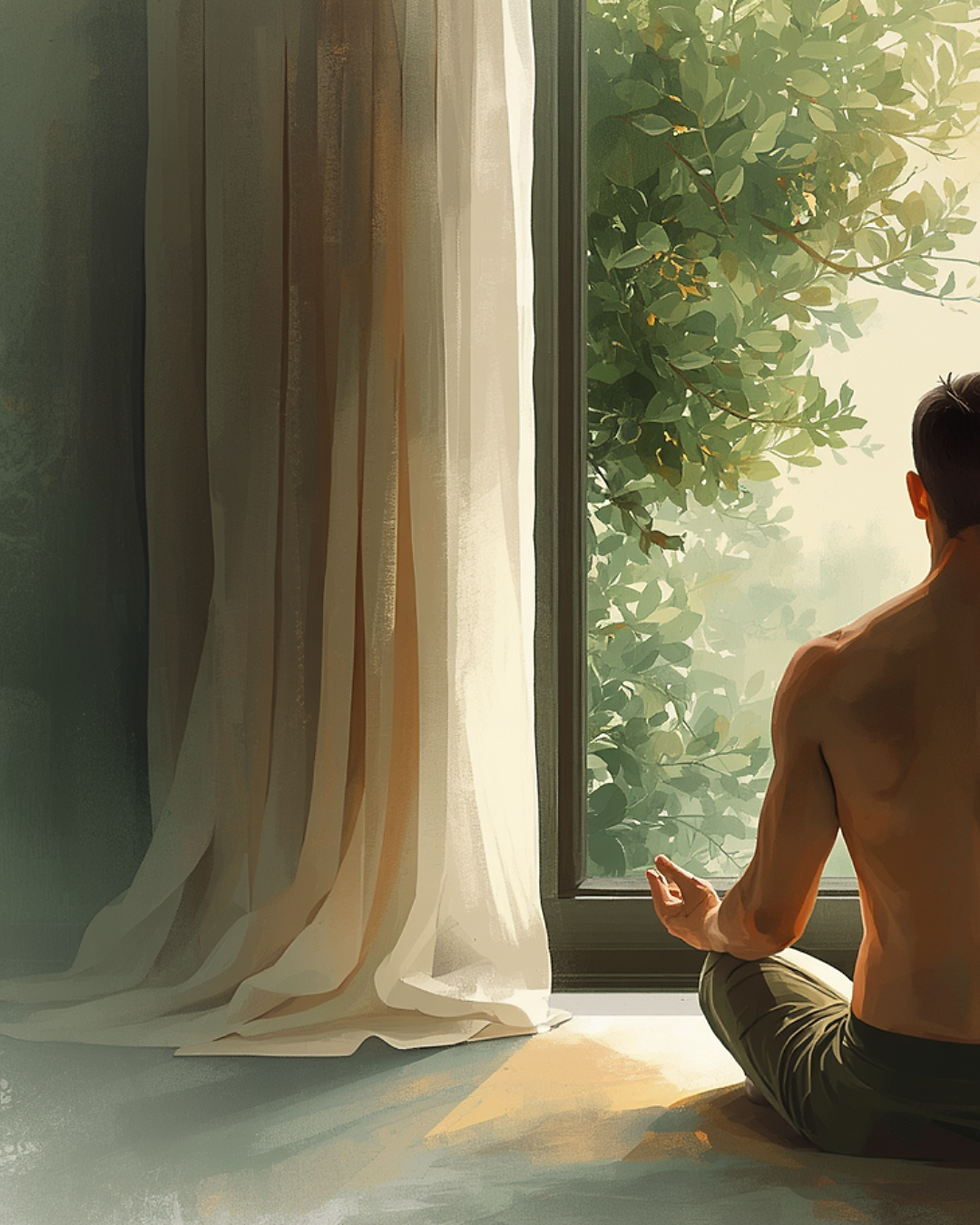
A moment of stopping.
Stopping the war against their own inner experience. The fear. The grief. The what-ifs that circle at three in the morning. The exhaustion of trying to feel differently than they actually feel.
And in that moment of stopping — something shifts.
Not in the disease. In the quality of the day. In the way they move through it.
Science has been quietly studying this shift for years. And what it is finding lines up, with surprising precision, with what every contemplative tradition has pointed to for centuries. Acceptance — real acceptance, not resignation — may be one of the most powerful moves available to someone living with cancer.
What Acceptance Actually Is
Before anything else, it helps to say what acceptance is not.
Acceptance is not approval. It does not mean agreeing that what is happening is fine, or that you are not allowed to be afraid, or that fighting the disease is wrong.
Acceptance is also not the same thing as resignation. Resignation withdraws from life. It says: nothing matters, so I will stop trying. That is a very different thing — and the research is clear that resignation is actually associated with more distress, not less.
Acceptance means allowing your experience — your fear, your grief, your exhaustion, your uncertainty — to be real, without spending all your energy trying to push it away.
Think of it like this. When you are swimming and a wave arrives, you have two choices. You can fight against it — and it will wear you out. Or you can let it move through you, stay loose, and surface on the other side. Acceptance is learning to stay loose. Learning to let the waves move through you instead of breaking yourself against them.
What the Research Shows
In 2024, a systematic review and meta-analysis published in Frontiers in Psychology examined all available randomized controlled trials on Acceptance and Commitment Therapy — known as ACT — in cancer patients. The finding was clear: ACT significantly reduces psychological distress, anxiety, and depression in people living with and recovering from cancer. Not slightly. Significantly.
ACT is a type of psychological support built on a deceptively simple idea: instead of trying to change or eliminate difficult thoughts and feelings, you learn to hold them differently. You acknowledge them without being controlled by them. You allow them to exist while still choosing actions that align with what matters most to you.
A 2025 scoping review published in Cancer Reports deepened the picture. Looking across the full body of literature on acceptance in cancer patients, the researchers found that people who were able to accept their illness — not approve of it, simply allow it to be real — consistently showed lower distress than those who could not. Lower anxiety. Lower depression. Better quality of life.
And a randomized clinical trial, published in 2025 in JAMA Network Open, found that cancer survivors who participated in an acceptance-based intervention showed meaningful improvements in well-being compared to a control group. Small practices. Consistent application. Real results.
The message across all of this research is the same: the struggle against inner experience is costly. And choosing, gently, to stop that struggle — to simply allow — changes something real in the body and the mind.
“Acceptance is freedom because you are ultimately deciding to stop fighting yourself.”
— Yung Pueblo
What Ancient Wisdom Knew First
The wisdom traditions did not have randomized controlled trials. But they arrived at the same conclusion.
Yung Pueblo, writing this week about the nature of letting go, describes what he calls “the phantom of past pain” — the grief, the fear, the difficult feelings that persist not because they are permanent truths, but because we keep feeding them with our resistance. When we stop fighting, he writes, the phantom gradually loses its grip. Not immediately. Not dramatically. But steadily, with time.
Dan Koe, approaching the same territory from a very different angle, makes the distinction precisely: “Pain is a feature of life. Suffering is the identity’s refusal to accept the event.”
The pain of a diagnosis — the physical reality, the disruption, the uncertainty — is real. But the suffering that compounds it? That is often something we are adding ourselves. Not through weakness. Through being human. Through having a nervous system trained, since childhood, to fight anything that feels threatening.
Bentinho Massaro, describes the path as one of “becoming transparent” — not acquiring more strength, but allowing the defended layers to thin, until what was always underneath is quietly revealed.
The invitation running through all of it is the same:
not to be stronger, but to be softer.
Not to push harder, but to allow more.
What This Looks Like in Practice
For someone navigating cancer, this is not abstract.
It looks like allowing yourself to feel afraid for sixty seconds — without immediately trying to manage or eliminate that feeling. Just sitting with it, observing it, and noticing that it does not destroy you.
It looks like noticing grief without immediately labeling yourself as someone who is not coping. Grief is not a sign of failure. It is a sign that something mattered.
It looks like sitting with uncertainty — even for a few minutes — instead of filling every quiet moment with research, planning, or worry. Not because planning is wrong, but because the nervous system also needs space to rest.
None of this requires hours of meditation or a complete transformation of your personality. The research on ACT is built on small, consistent practices. A few minutes of stillness. A breath taken before reacting. A moment of watching your thoughts rather than being swept along by them.
At Holistic Path, this is the foundation of everything. The nervous system first. Calm as a prerequisite. Not pushing for dramatic change, but building — slowly, sustainably — the capacity to rest inside difficulty rather than fight it.
Because when the nervous system settles, other things become possible. Rest improves. Decisions become clearer. The body begins to find its way back toward its own natural healing capacity.
A Place to Begin
There is a quiet revolution available to anyone living with cancer. It does not make the diagnosis disappear. It does not fast-forward through the hard parts.
But it changes the quality of every moment you pass through them.
Today — just once — try this. When a difficult feeling arrives, instead of trying to fix it or push it away, simply say to yourself: this is here. I can feel this and still be alright.
Take one slow breath.
Notice that you are still here on the other side of it.
That space — the one that opens when you stop fighting — is where healing lives.
No noise. Just thoughtful emails when it matters.
Sources
1. “Acceptance and commitment therapy reduces psychological distress in patients with cancer: a systematic review and meta-analysis of randomized controlled trials.” Frontiers in Psychology, 2024. PubMed ID: 38250124.
2. Dekker et al. “Acceptance in Patients With Cancer: A Scoping Review.” Cancer Reports, 2025. PMC12573780.
3. “Enhancing Well-Being in Cancer Survivors Through Acceptance and Commitment Therapy: A Randomized Clinical Trial.” JAMA Network Open / PubMed, 2025. PubMed ID: 41556029.
4. “The Relationship between Acceptance of Cancer and Distress: A Meta-Analytic Review.” PMC, 2020. PMC7010402.


Comments